Boil Water Advisory: What to Do — and What Boiling Can't Fix
The core instruction is one sentence: a full rolling boil for one minute. The details that matter are which type of advisory you're under, what boiled water covers, and why boiling never fixes a chemical problem.
By Max — Founder, builder of TapGraded's EPA data pipeline · July 15, 2026 · Updated July 18, 2026
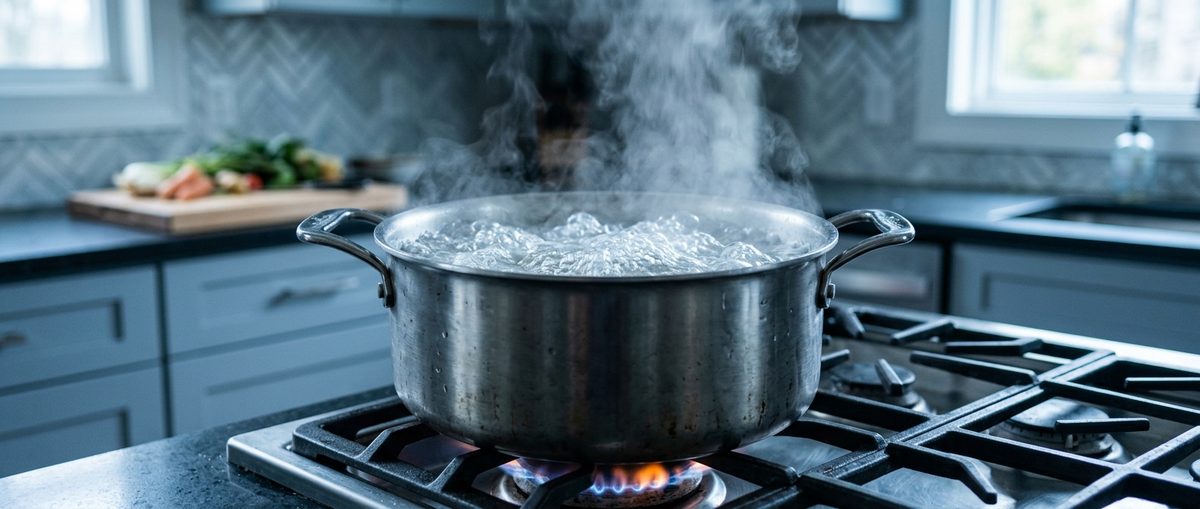
A boil water advisory has one core instruction: bring tap water to a full rolling boil for one minute before you drink it or cook with it. The advisory means your utility has reason to believe the water is, or could be, contaminated with disease-causing germs — usually after a main break, a pressure loss, or a treatment failure. Boiling kills those germs. Everything else in this article is detail, but the detail decides whether the boiling actually protects you.
First, check which advisory you’re under
The CDC recognizes three distinct types of drinking water advisory, and they call for different — sometimes opposite — responses:
- Boil water advisory. The suspected problem is microbial: bacteria, viruses, parasites. Boiling works. This article covers this case.
- Do not drink advisory. The suspected problem is chemical or toxin-based — arsenic, nitrate, algal toxins. Boiling water containing harmful chemicals does not make it safe, per the CDC. Use bottled water for drinking, cooking, brushing teeth, formula, ice, and pets.
- Do not use advisory. Rare. Any contact with the water — skin, lungs, eyes — could be dangerous. Bottled water for everything.
Read the notice’s exact wording before doing anything. Boiling is the right response to a microbial problem and the wrong response to a chemical one; the EPA states plainly that “boiling or disinfection will not destroy other contaminants, such as heavy metals, salts, and most other chemicals.” Boiling does nothing for lead, for example — that is a separate problem with a separate regulatory framework.
How to boil correctly
- Bring the water to a full rolling boil for at least one minute.
- At high altitude, boil for three minutes — EPA sets that threshold at 5,000 feet, the CDC version of the guidance at 6,500. If you live at elevation, take the longer boil.
- Let it cool on its own. Do not cool it with ice made from unboiled tap water.
- If the water is cloudy, let it settle and filter it through a clean cloth, paper towel, or coffee filter first, then boil.
Two rules that get missed:
- A filter is not a substitute for boiling. The CDC is explicit: boil your tap water even if it has been through a pitcher filter or home filter.
- Skip the refrigerator dispenser. During any advisory, do not use water or ice from appliances connected to your water line — the fridge’s dispenser and ice maker included.
What boiled water covers, room by room
Boiled (then cooled) water — or commercially bottled water — is what you use for drinking, cooking, preparing food, washing produce, making ice, and mixing infant formula. For everything else, the CDC’s guidance is specific:
- Brushing teeth: boiled or bottled water only. Unboiled tap water is the same exposure as drinking it.
- Infant formula: ready-to-use formula is the safest option during an advisory; otherwise mix with boiled or bottled water and sanitize all bottles.
- Handwashing: tap water and soap are usually acceptable — follow your local officials’ instructions.
- Bathing and showering: fine, as long as no one swallows water. Give babies and young children sponge baths to reduce the chance of swallowing.
- Dishes: a dishwasher is generally safe if it has a sanitizing cycle or a final rinse of at least 150°F. Washing by hand, follow the CDC’s four steps: wash and rinse with hot water, then soak the rinsed dishes at least one minute in a basin of warm water with one teaspoon of unscented household bleach per gallon, then air-dry completely.
- Laundry: safe as usual.
- Pets: give them boiled (cooled) or bottled water. Pets can get sick from the same germs, and can pass some of them back to you.
- Plants and garden: tap water is fine, including for plants you eat.
If you cannot boil
The EPA’s fallback for clear water is disinfection with unscented household liquid bleach, at exact doses: 8 drops of 6% bleach per gallon of water, or 6 drops of 8.25% bleach per gallon — 2 drops per quart for either strength. Stir, then let it stand for 30 minutes. If the water is cloudy, colored, or very cold, filter or settle it first and double the bleach amount. Do not improvise the ratio, and do not use scented or splashless bleach. Bottled water, when available, is simpler and preferred.
When the advisory is lifted
Your utility’s all-clear notice will include flushing instructions — typically running cold taps for several minutes, discarding ice made during the advisory, and running appliance water lines through a few cycles before use. Follow the notice’s specifics; the utility knows which parts of the system were affected.
Advisories are also a data point. A system that issues them frequently is telling you something about its infrastructure. You can check your utility’s violation history and detected contaminants, see how its Tap Grade is computed, and read its annual report — here is how to read your Consumer Confidence Report.
Sources
- US EPA — “Emergency Disinfection of Drinking Water” — https://www.epa.gov/ground-water-and-drinking-water/emergency-disinfection-drinking-water
- Centers for Disease Control and Prevention — “Drinking Water Advisories: An Overview” — reviewed March 4, 2024 — https://www.cdc.gov/water-emergency/about/drinking-water-advisories-an-overview.html
- US EPA — “National Primary Drinking Water Regulations” — https://www.epa.gov/ground-water-and-drinking-water/national-primary-drinking-water-regulations
Source: Regulatory facts cited inline against EPA sources; see Methodology & Data sources · Data as of July 18, 2026
This article is informational and is not health, legal, or engineering advice. Questions or corrections: contact@tapgraded.com.