Lead in Water: Action Level vs. MCL (and Why Lead Has No MCL)
The health goal for lead is zero. The enforceable trigger is 15 ppb, dropping to 10 ppb in November 2027. Neither is a safe line — and knowing the difference changes how you read any lead result.
By Max — Founder, builder of TapGraded's EPA data pipeline · July 13, 2026 · Updated July 18, 2026
Three numbers govern lead in US drinking water. The federal health goal is zero. The enforceable trigger — the action level — is 15 parts per billion, and it drops to 10 ppb on November 1, 2027. None of the three is a “safe” line. Lead is the one major drinking-water contaminant with no Maximum Contaminant Level at all, and that single fact changes how a lead result should be read.
Why lead has no MCL
For every regulated contaminant the EPA publishes two values: the MCLG, a non-enforceable health goal, and usually an MCL, the enforceable limit. For lead, the MCLG is zero, because the EPA’s position is that there is no safe level of exposure to lead — it is a toxic metal that accumulates in the body over time.
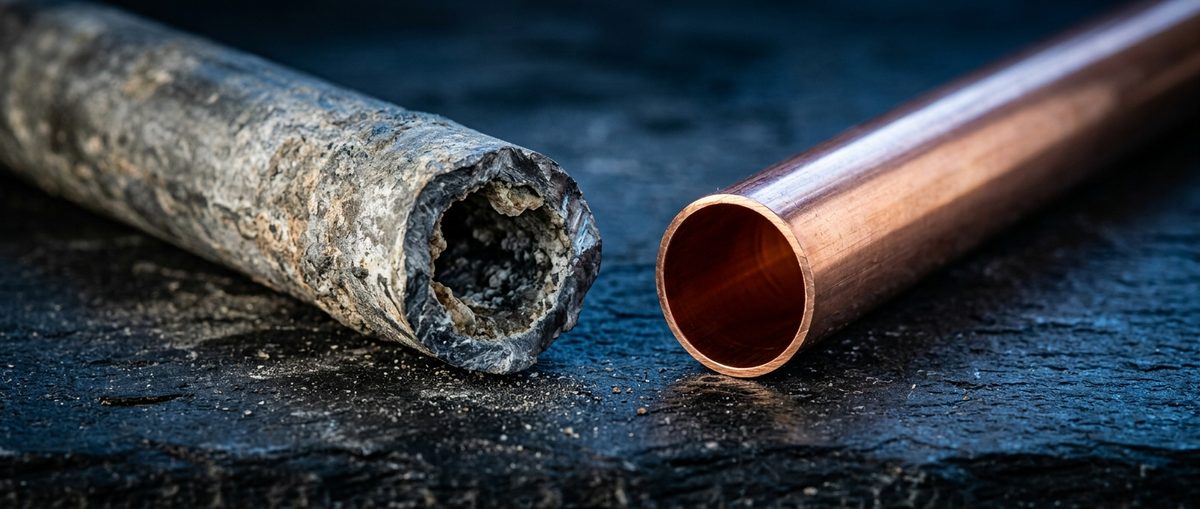
An enforceable MCL of zero is not workable, and an MCL above zero would misstate the science. There is also a structural problem: lead usually is not in the water when it leaves the treatment plant. It enters afterward, through corrosion of lead service lines — the pipes connecting homes to the water main, which the EPA calls the most significant source where they exist — plus lead solder and brass or chrome-plated brass fixtures inside homes. A utility cannot be held to a concentration limit at a tap whose plumbing it does not own.
So lead is regulated differently: a treatment technique under the Lead and Copper Rule. The utility’s obligation is to control corrosion and replace lead pipes, and the measurement regime exists to test whether that work is succeeding.
What the action level actually is
Under the Lead and Copper Rule, systems sample taps at higher-risk homes and compute the 90th-percentile result — the level that 90% of samples fall below. If that value exceeds the action level of 15 ppb, the system must act: optimize corrosion control, conduct public education, and in many cases replace lead service lines.
The action level is a trigger for system-wide action. It is not a health threshold, and clearing it does not certify any individual tap. Both directions of the mismatch matter:
- The system can be below 15 ppb while your tap, fed by a lead service line, is well above it.
- The system can exceed the action level while your particular house, with copper plumbing throughout, pours water with no detectable lead.
The number describes the distribution across sampled homes. Your house is one data point the sample probably did not include. That is why the Tap Grade treats a system’s lead 90th-percentile result as one signal among several rather than a verdict on your kitchen faucet.
The health case, briefly
The reason the goal is zero, per the EPA’s summary of the evidence: children are the most vulnerable — low-level exposure is linked to learning disabilities, slowed growth, and hearing problems — and the CDC uses a blood lead reference value of 3.5 micrograms per deciliter to identify children with elevated exposure. During pregnancy, lead can cross to the fetus, with risks including reduced fetal growth and premature birth. In adults, exposure is associated with cardiovascular and reproductive effects.
One practical note from the same source: skin does not absorb lead from water. Showering and bathing in water with elevated lead is not the exposure route; drinking and cooking are.
Where the lead is
Lead pipes are more likely in older cities and in homes built before 1986, when lead solder was still standard. The definition of “lead free” has tightened since: a 2011 amendment to the Safe Drinking Water Act cut the allowable lead content of new pipes, fittings, and fixtures to 0.25% (0.2% for solder and flux). Fixtures sold before that standard can legally contain much more.
What changes in 2027
The Lead and Copper Rule Improvements (LCRI), finalized October 8, 2024, tighten most of this framework:
- The action level drops from 15 ppb to 0.010 mg/L — 10 ppb — starting November 1, 2027.
- Water systems must identify and replace lead service lines within 10 years.
- Tap sampling becomes more rigorous, and systems must tell residents where lead pipes are and publish plans for replacing them.
A system that sits at 12 ppb today is compliant; the same result in November 2027 puts it over the new action level. Grades and records will shift when the threshold does, without any change in the water.
What to do with all this
- Look up your system’s lead 90th-percentile figure on its lead contaminant page and in its annual report — here is how to read the CCR.
- If your home predates 1986 or has a known lead service line, test your own tap. The system’s number cannot stand in for yours in either direction.
- If a test confirms lead, use a filter certified specifically for lead reduction — see our lead filter guide. Boiling does not remove lead — heavy metals survive a boil; certified filtration, flushing, or line replacement are the tools that work.
Sources
- US EPA — “Basic Information about Lead in Drinking Water” — https://www.epa.gov/ground-water-and-drinking-water/basic-information-about-lead-drinking-water
- US EPA — “Lead and Copper Rule” — https://www.epa.gov/dwreginfo/lead-and-copper-rule
- US EPA — “Lead and Copper Rule Improvements” — finalized October 8, 2024 — https://www.epa.gov/ground-water-and-drinking-water/lead-and-copper-rule-improvements
- US EPA — “Final LCRI: Frequently Asked Questions for States and Public Water Systems” — October 2024 — https://www.epa.gov/system/files/documents/2024-10/final_lcri_faq_statespws.pdf
- US EPA — “National Primary Drinking Water Regulations” — https://www.epa.gov/ground-water-and-drinking-water/national-primary-drinking-water-regulations
Source: Regulatory facts cited inline against EPA sources; see Methodology & Data sources · Data as of July 18, 2026
This article is informational and is not health, legal, or engineering advice. Questions or corrections: contact@tapgraded.com.