Well Water Testing 101: You're the Utility Now
More than 43 million Americans drink from private wells no agency tests. The annual routine that covers you takes one lab order a year — here's exactly what to test, when, and where.
By Max — Founder, builder of TapGraded's EPA data pipeline · July 14, 2026 · Updated July 18, 2026
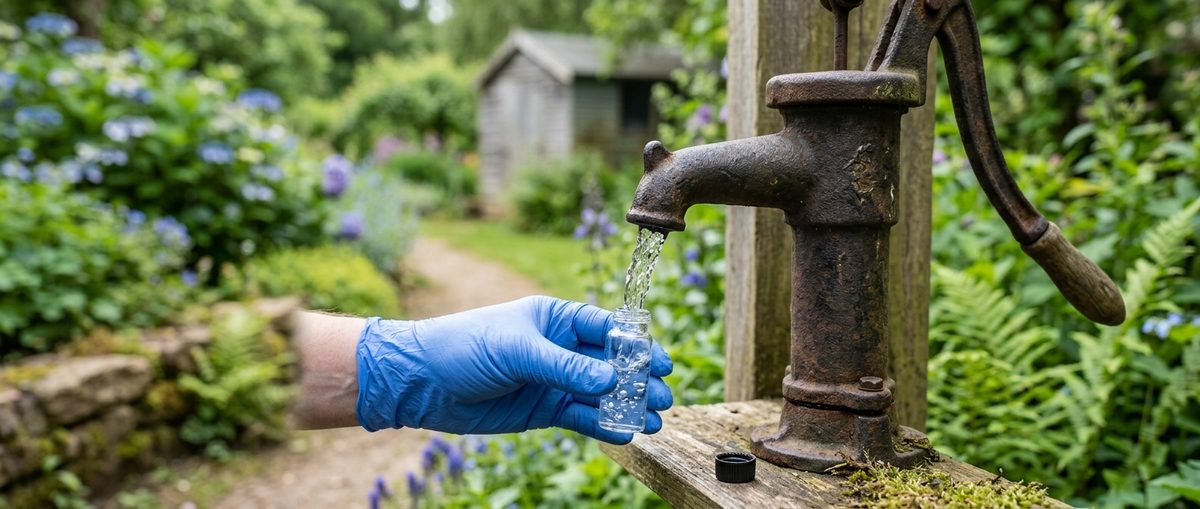
Maybe the well came with the house, and somewhere between the closing papers and the moving boxes it hit you: nobody is watching this water but you. That instinct is correct — private wells are not regulated under the Safe Drinking Water Act. No utility treats your water, no agency schedules its testing, and no annual report arrives in your mailbox. You’re the utility now.
Here’s the part that should steady you: you’re in enormous company, and the job is smaller than it feels. The EPA counts more than 43 million people — about 15% of the country — relying on private wells, and the entire baseline responsibility comes down to one lab order a year plus a walk-around every spring. You can absolutely run this.
Why the test matters (the honest number)
Not as a scare — as a reason the routine earns its place on your calendar: when the US Geological Survey sampled about 2,100 private wells, roughly one well in five contained at least one contaminant above a human-health benchmark. Four in five didn’t. The only way to know which side of that line your well is on is a test, because the contaminants that matter most — bacteria, nitrate, arsenic — have no taste, color, or smell.
Your annual baseline: four things, once a year
The CDC’s guideline for every well owner, everywhere: test at least once every year for:
- Total coliform bacteria. Coliforms are mostly harmless themselves — they’re the smoke alarm, not the fire. They travel the same paths as disease-causing germs (a compromised well cap, a septic leak, surface runoff), and they’re far easier to test for. A positive E. coli result is more specific: it likely means fecal contamination has reached your water.
- Nitrate. It arrives from septic systems, fertilizer, farm runoff, and animal waste. The federal limit for public systems is 10 mg/L as nitrogen, and it matters most in homes mixing infant formula — high nitrate is dangerous for babies specifically.
- Total dissolved solids. A rough gauge of everything mixed into your water; rising TDS is an early sign something changed underground.
- pH. Water that’s too acidic or too basic can damage your pipes — and damaged pipes can leach metals like lead into otherwise clean water.
That’s the whole federal-guidance baseline. One sampling kit, one lab, once a year.
Then build your local list — once
Your well’s real risk profile depends on your geology and your neighbors, and you only have to research it once. The CDC’s advice is to ask your local health or environmental department — or the EPA’s Drinking Water Hotline at (800) 426-4791 — which of these deserve a place on your rotation:
- Arsenic — naturally occurring in groundwater in many regions
- Lead and mercury
- Volatile organic compounds — fuel and industrial chemicals like benzene or MTBE, if you’re near current or former industry
- Radium and other radionuclides, in certain geologies
- Pesticides or herbicides, in agricultural areas
- PFAS, worth asking about where firefighting foam or industrial sources are known nearby
Write the answer down. That list plus the annual four is your complete testing program.
The calendar (and the life events that reset it)
- Every spring: check the well for mechanical problems, per the CDC’s schedule, and run the annual test.
- Retest right away after flooding or land disturbance near the well, after any repair to the well system, if you’re notified of well problems in your area, or if the water’s taste, color, or smell changes.
- Two triggers people don’t expect: the CDC also says to retest when someone in the house becomes pregnant, or when a child moves in. Smaller bodies and developing systems have thinner margins — the water that was fine for you deserves a fresh look for them.
A clean result five years ago guarantees nothing today; groundwater moves. That’s not a reason for dread — it’s the reason the test is annual.
Use a real lab (the strips are just scouts)
Hardware-store test strips are fine for a quick look between tests. Your actual annual result should come from a state-certified laboratory — your health department or county keeps a list of certified labs, and many health departments will test the core indicators themselves. Our state-by-state well water guides point to the right starting agency where you live.
If a result comes back bad
First: this is a solvable problem, and you found it — which is the whole point of testing. The CDC’s sequence is to switch to bottled or another safe source right away, then call your health department; they’ll help you interpret the numbers and plan the fix. When treatment is the answer, match it to the specific contaminant you found — our filter guides show which technologies hold certifications for what, and the filter match tool does the pairing for you. Test first, treat second, and never pay for treatment aimed at a problem you don’t have.
This week
One action: find your health department’s number (it’s in our well water guides) and book the annual test — or if it’s been years, book the baseline four today. By next spring it won’t be a project anymore. It’ll just be the thing you do when you check the well cap — the fifteen-minute habit that makes your water the one utility in the country with a customer-to-operator ratio of one.
Sources
- US EPA — “Private Drinking Water Wells” — https://www.epa.gov/privatewells
- Centers for Disease Control and Prevention — “Guidelines for Testing Well Water” — reviewed July 1, 2024 — https://www.cdc.gov/drinking-water/safety/guidelines-for-testing-well-water.html
- US EPA — “Contact Information for Certification Programs and Certified Laboratories for Drinking Water” — https://www.epa.gov/dwlabcert/contact-information-certification-programs-and-certified-laboratories-drinking-water
- US EPA — “National Primary Drinking Water Regulations” — https://www.epa.gov/ground-water-and-drinking-water/national-primary-drinking-water-regulations
Source: Regulatory facts cited inline against EPA sources; see Methodology & Data sources · Data as of July 18, 2026
This article is informational and is not health, legal, or engineering advice. Questions or corrections: contact@tapgraded.com.