Hard Water vs. Unsafe Water: Which Problem Are You Paying to Fix?
Scale on the showerhead doesn't mean your water is dangerous — and a softener won't make unsafe water safe. Here's the evidence on hardness and health, and which fix is actually worth your money.
By Max — Founder, builder of TapGraded's EPA data pipeline · July 16, 2026 · Updated July 18, 2026
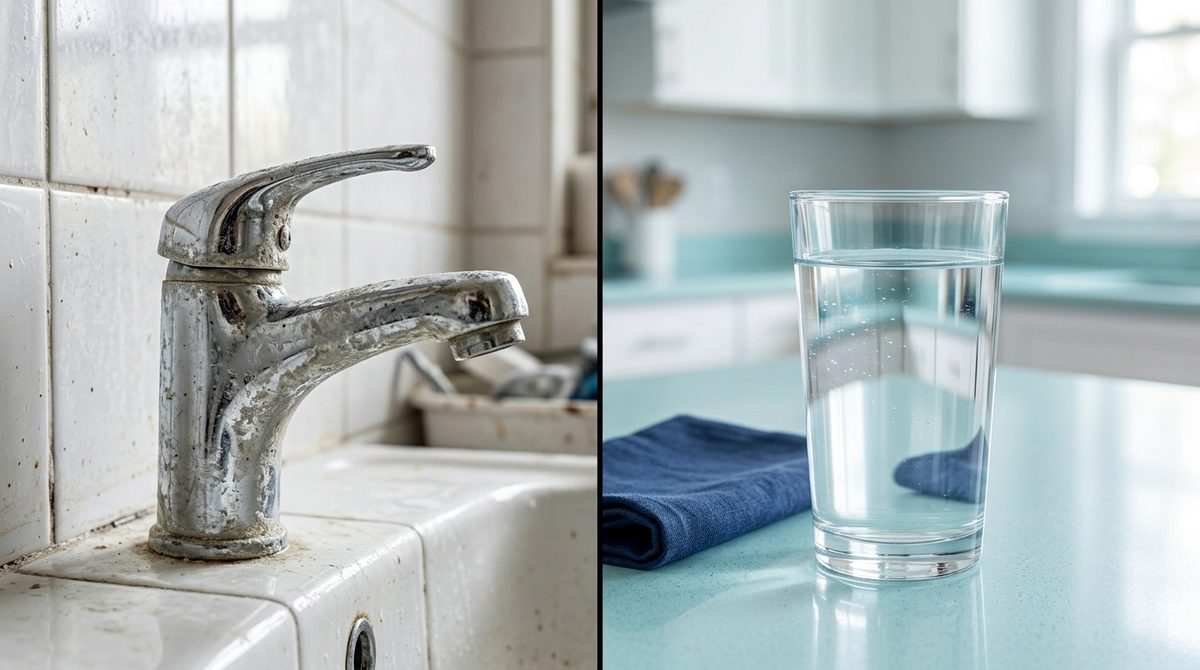
Your showerhead is crusted white, your glasses come out of the dishwasher spotted, and someone — often someone selling water softeners — has suggested that’s a water-quality problem. Before you spend anything, it’s worth asking the question precisely: is my water unsafe, or just hard? Those are two different problems, measured on different scales, regulated under different rules, and fixed by different equipment. Confuse them and you can spend real money solving the one you don’t have.
What is hard water, exactly?
Hardness is the amount of dissolved calcium and magnesium in your water, picked up as groundwater moves through mineral-rich rock like limestone and chalk. The US Geological Survey measures it in milligrams per liter of calcium carbonate and sorts it into four bands:
- Soft: 0–60 mg/L
- Moderately hard: 61–120 mg/L
- Hard: 121–180 mg/L
- Very hard: more than 180 mg/L
Those minerals are what you’re scraping off the faucet. Heated, they precipitate out as scale in pipes, water heaters, and kettles; in the shower, they react with soap to leave the film that keeps it from lathering. Every one of those effects is real, visible — and cosmetic or mechanical, not toxicological. At very high levels you may also taste hardness: the World Health Organization puts the taste threshold for calcium at roughly 100–300 mg/L.
You don’t have to guess your number. A test strip from any hardware store reads hardness directly, and many utilities report it — see how to read your Consumer Confidence Report.
Is hard water a health risk?
The claim, usually implied rather than stated: if minerals are building up in your pipes, imagine what they’re doing inside you.
The evidence points the other way. The USGS states plainly that hardness is not a health concern. The WHO reviewed the health literature on calcium and magnesium in drinking water and declined to set any guideline value at all — its 2011 background document concludes there are “insufficient data to suggest either minimum or maximum concentrations of minerals at this time, and so no guideline values are proposed.” Calcium and magnesium are essential nutrients; the same document notes drinking water can meaningfully contribute to dietary intake for people whose diets run low on them.
To steelman the health angle fairly: the research questions that do exist mostly run in hardness’s favor, not against it. Epidemiological studies have examined whether magnesium in drinking water is associated with lower cardiovascular mortality — the WHO document reports statistically significant benefits generally appeared at magnesium concentrations of about 10 mg/L and greater, while cautioning the evidence “is being debated and does not prove causality.” The one commonly cited downside is skin: hard water has been suggested as a factor that could exacerbate eczema, and the same WHO review describes the evidence as mixed — a suggested mechanism involving soap residues, studies in children with inconsistent results, and trials still under way.
Verdict: hard water is a nuisance with a maintenance bill, not a hazard with a health bill.
What does “unsafe water” actually mean?
Unsafe water is a different category entirely: health-based contaminants the EPA regulates under the National Primary Drinking Water Regulations because of documented health effects — lead, nitrate, arsenic, PFAS, disinfection byproducts, and microbial contamination like E. coli. Each has an enforceable Maximum Contaminant Level, or in lead’s case an action level, which works differently. These are the substances the Tap Grade is built around.
Where does hardness sit in that regulatory scheme? Nowhere. It has no MCL, and it doesn’t even appear on the EPA’s secondary standards — the non-enforceable list for aesthetic nuisances like odor, color, and staining. The agency that sets legal limits on more than 90 contaminants in drinking water looked at hardness and didn’t put it on either list.
The practical consequence cuts both ways: your water can be very hard and perfectly safe, or silky soft with a genuine lead or nitrate problem. Hardness tells you nothing about safety, in either direction.
The softener pitch, tested
Here’s the honest version of the sales pitch, because parts of it hold up.
The pitch: scale shortens the life of your water heater and appliances, wastes soap and detergent, and spots everything it dries on. A softener fixes all of that. This is true. The WHO document acknowledges that soft or softened water allows more efficient heat transfer in water heaters and probably extends their life, and softer water demonstrably lathers better and leaves less residue. If your water tests very hard and you’re on your second scale-choked water heater, a softener is a legitimate purchase.
The test: does any of that make your water safer? A standard softener works by ion exchange — as the WHO describes it, each calcium or magnesium ion is swapped for two sodium ions. It’s a mineral trade, not a purification step. The CDC’s rundown of home water treatment is precise about the boundaries: softeners remove minerals, primarily calcium and magnesium; some models may also reduce iron, manganese, or certain other metals — check the specific product’s label — but no softener removes parasites, bacteria, or viruses, and a softener is not a certified treatment for the contaminant you’re actually worried about. If lead, nitrate, or PFAS is the concern, the right tool is a filter certified for that specific contaminant, not a mineral swap.
Two trade-offs come with the swap itself, per the WHO document: softened water carries more sodium and chloride than the water that went in, and it carries less calcium and magnesium — which is why a common installation choice is to leave the kitchen cold tap (or the whole cold line) unsoftened, so the water you actually drink keeps its minerals and skips the added sodium.
Soft water isn’t automatically safe, either
The inverse mistake is rarer but worth naming: assuming soft water means clean water. Naturally soft water tends to be aggressive — the WHO notes that unstabilized soft water corrodes metal pipes, which can put cadmium, copper, lead, and zinc into the water on its way to your tap. That’s precisely why utilities stabilize soft water before distributing it, and why lead — a plumbing problem, not a source-water problem — has to be tested at your own faucet.
So all four combinations exist:
- Hard and safe — the most common case. Annoying appliances, fine water.
- Hard and unsafe — scale and a real contaminant. The softener fixes half.
- Soft and safe — the water everyone assumes they have.
- Soft and unsafe — soft, corrosive water leaching lead from old plumbing.
You can’t tell which quadrant you’re in from the showerhead.
Which problem do you have? A three-step check
- Get your hardness number. A hardness test strip from the hardware store reads it directly, or check your utility’s water quality report. Under 120 mg/L, scale probably isn’t your problem; over 180, it probably is.
- Get your safety picture separately. Look up your utility’s violation history and detected contaminants and its Tap Grade. For anything that enters from your own plumbing — lead above all — test at the tap, because no city report can see your pipes.
- Match the fix to the finding. Scale problem → softener. Contaminant problem → a filter certified for that contaminant; our filter match tool maps contaminants to certified filter types, and if you’re weighing the two big options, here’s reverse osmosis vs. carbon.
The verdict
A water softener is worth pricing out if your water tests hard or very hard and you’re seeing the damage — scale-killed heating elements, crusted fixtures, soap that won’t rinse. It is the wrong purchase if what worries you is lead, nitrate, arsenic, PFAS, or bacteria: it isn’t designed to remove them, and no demonstration of how slick softened water feels changes that. And if a pitch slides from “your water is hard” to “your water is dangerous” without a lab result in between, that’s not a diagnosis — that’s a sales technique. Get the two numbers separately, and pay only for the problem you actually have.
Sources
- US Geological Survey — Water Science School — “Hardness of Water” — https://www.usgs.gov/special-topics/water-science-school/science/hardness-water
- World Health Organization — “Hardness in Drinking-water: Background document for development of WHO Guidelines for Drinking-water Quality” — 2011 — https://cdn.who.int/media/docs/default-source/wash-documents/wash-chemicals/hardness-bd.pdf
- Centers for Disease Control and Prevention — “About Home Water Treatment Systems” — reviewed April 10, 2024 — https://www.cdc.gov/drinking-water/about/about-home-water-treatment-systems.html
- US EPA — “Secondary Drinking Water Standards: Guidance for Nuisance Chemicals” — https://www.epa.gov/sdwa/secondary-drinking-water-standards-guidance-nuisance-chemicals
- US EPA — “National Primary Drinking Water Regulations” — https://www.epa.gov/ground-water-and-drinking-water/national-primary-drinking-water-regulations
Source: Regulatory facts cited inline against EPA sources; see Methodology & Data sources · Data as of July 18, 2026
This article is informational and is not health, legal, or engineering advice. Questions or corrections: contact@tapgraded.com.